"If you're in the market for a professional, knowledgeable, and dependable Managed Service Provider, then look no further than M.A. Polce."
Scott L.
Onondaga Free Library
"We appreciate the partnership that M.A. Polce has brought to our managed IT services. They provide excellent support but also serve as a resource for us to discuss our IT environment and develop plans for improvement, change, and growth."
Rachel S.
Nunn's Home Medical Equipment
"We've developed a sense of trust that is unique in this business and we'd be hard pressed to move from them going forward."
Bob F.
NextGen Label Group
“When we have an issue or put in a ticket, it is resolved quickly. Everyone we have spoken to is professional and polite. No issues at all. Overall, I am extremely pleased with the move to M.A. Polce.”
Frances S.
Empire State Medical, Scientific and Educational Foundation, Inc.
When IT Support Falls Behind, Everything Else Does Too
Whether you’re running with an IT provider you can’t rely on or your internal staff is stretched across too many priorities, the outcome looks the same. Technology decisions get made reactively, security gaps go unnoticed until it’s too late, and the people responsible for keeping you running never have time to plan ahead.
You need more than a help desk. You need a team that closes the gap between where your IT is and where your business needs it to be.
Firefighting, Not Forecasting
Problems get solved after they've already cost you time, instead of being caught before they start.
Security Blind Spots
Threats evolve faster than a stretched team can monitor, patch, and respond to them.
One Person, Every Hat
A single IT contact (or none) can't be your help desk, security officer, and strategist all at once.
No Room for Strategy
When every day is reactive or you're always waiting for a response, there's no bandwidth left to plan for growth, budget, or what's next.
A Straightforward Path to Better IT Support, In Three Steps
Whether you’re looking to fully outsource your IT or bring in support to strengthen the team you already have, the process starts the same way: we listen first. Here’s what working with us looks like from the first conversation to full support.
Step 1
Discovery Call
We start with a candid conversation to understand your needs and current challenges. On this call, we’ll ask questions to learn about your environment, your business goals, and what you’re looking for in an IT partner, whether that’s full-service support or a partner to work alongside your existing team.
Step 2
In-Depth Evaluation & Custom Proposal
Next, a technical resource conducts a deeper evaluation of your infrastructure, often in person, to see what’s working and where the risks and inefficiencies exist. From there, we build a custom proposal with a clear cost estimate and walk you through it so you know exactly what you’re getting before you decide anything.
Step 3
Onboarding & Ongoing Support
Once you’re ready to move forward, we kick off onboarding, typically completed within a month. We build the transition around your schedule to minimize disruption and avoid downtime for your team. From there, your IT is in expert hands. You get to focus on running your business while we handle the rest.
IT Support Services that New York Businesses Trust
The right IT partner doesn’t just fix things when they break. You should feel the difference in how your business runs day to day. We believe responsive support and clear communication are baselines, not “nice-to-haves,” and we work to earn our clients’ complete trust. Here’s what that looks like in practice.
Fewer Surprises, More Control
Instead of reacting to whatever breaks next, you get a roadmap that aligns your technology with where your business is headed.
Trust that Allows You to Relax
Enjoy the peace of mind brought by having a expert, reliable team of IT professionals supporting you day-to-day.
Time Back for What Matters
Whether IT was consuming your team's time or eating into your own, that time goes back to running and growing your business.
Confidence in Your Security
Core protections are part of your program, reinforced by 24x7 monitoring, threat detection, and rapid response.
Modern Technology Management & IT Support Essentials
From foundational infrastructure support to comprehensive management of your network, systems, and workstations, we’ll actively monitor and manage your IT environment 24x7x365.
Network, Server, and Device Support
24x7 support for your network, servers, and devices, so issues get resolved fast and your systems stay up and running.
Remote Monitoring and Management
We watch your infrastructure around the clock, catching problems before they cause downtime and keeping every system patched and secure.
Advanced IT Security Protection
24x7 threat detection and response, backed by several layers of security essentials to promote defense in depth and reduce cyber risk.
Proactive IT Services
Ongoing maintenance across your network, servers, backups, and workstations, plus full asset tracking, so nothing falls through the cracks.
Monthly Reporting
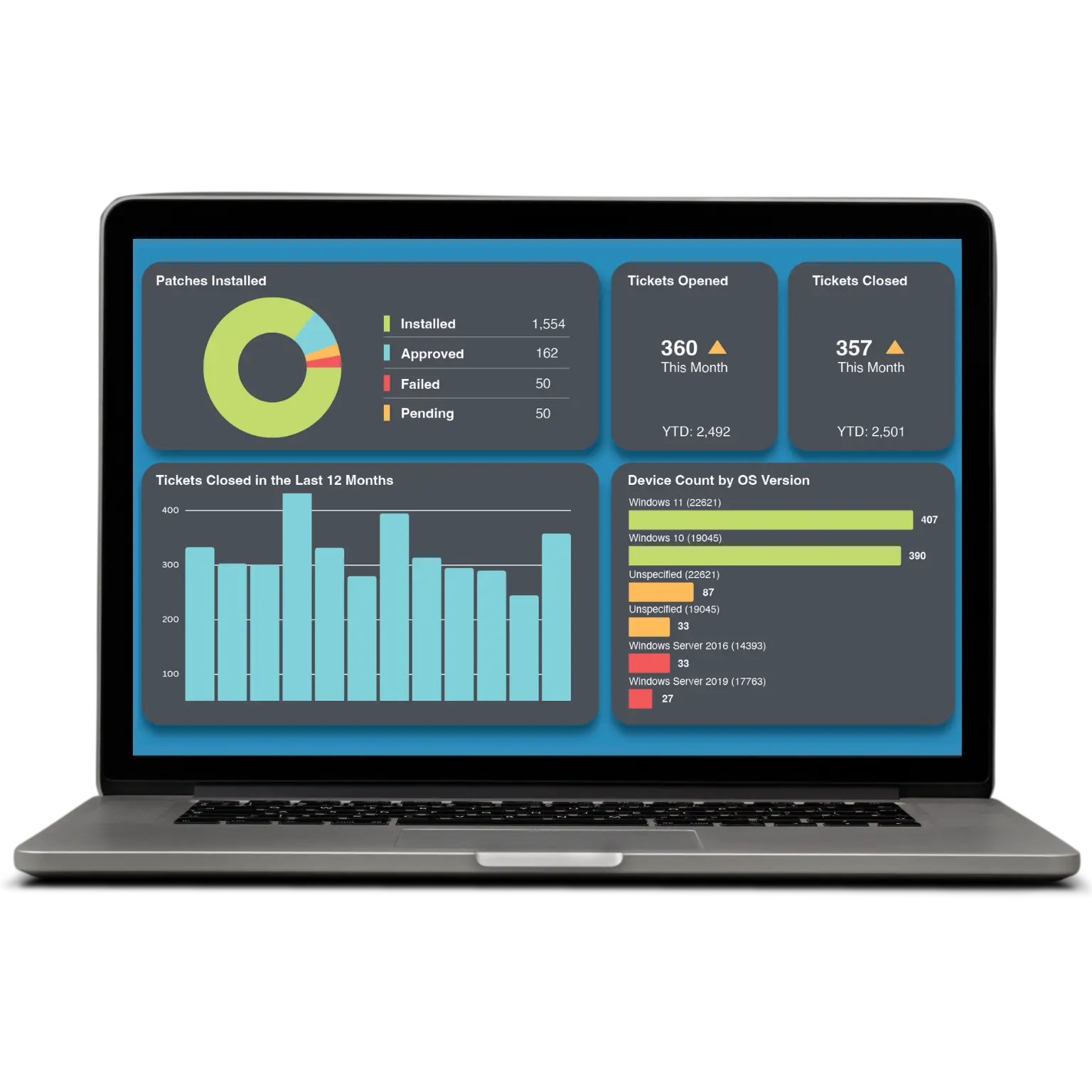
Clear, data-backed reports on ticket volume, response times, and device health so you always know how your IT program is performing.
Success Advisor
A dedicated advisor who knows your business, checks in regularly, provides recommendations, and keeps your IT program improving over time.
COMMON QUESTIONS
Frequently Asked Question About Managed IT Support Services
Things people in your position typically ask before or when they reach out.
Is outsourcing IT actually cost-effective compared to hiring in-house?
When you look at it side by side, it usually works out in your favor. A single in-house IT hire gives you one person’s skill set, one person’s availability, and one person’s bandwidth, and you’re still responsible for their training, tools, benefits, and eventual replacement. With a managed program, you get access to an entire team of certified professionals across multiple disciplines, for a cost that’s typically at or below what a single in-house hire would run.
That includes proactive monitoring and threat response, a strategic advisor helping you plan your technology budget, state-of-the-art data center resources, and someone tracking renewals so critical subscriptions and licenses never lapse. We also handle the hiring, training, and retention that come with keeping specialized talent in place, which is its own hidden cost most organizations underestimate until they’re the ones absorbing it.
If we choose co-managed IT, will you take over our IT department?
No, and this is one of the biggest misconceptions we run into. Co-managed support comes in a lot of different shapes, and we tailor it to what you need and your level of comfort. That could mean support for just workstations while your team handles servers and network infrastructure, or the reverse. It could be focused purely on patch management, Microsoft 365 administration, backup appliance monitoring, or data center hosting. It can also mean bringing in our team specifically for the rollout and support of MFA, security awareness training, or advanced protections, while your team continues to manage day-to-day operations. We’ll work with you to figure out where you need the most support and build a program around that, not a one-size-fits-all package.
Many of our strongest, longest-standing relationships are co-managed engagements where an internal IT manager finally has the backup, tools, and specialized support they’ve been asking for. The goal is to make your team more effective, not replace them.
How is M.A. Polce different from other IT providers?
Not every IT provider is solving the same problem, and it’s worth knowing what you’re actually comparing before you decide. Some providers exist to keep the lights on: they’ll respond when something breaks and otherwise stay out of your way. There’s a place for that model, but it’s not what we do. We work with organizations that want an IT partner actively involved in their business, not just their tickets. That means strategic advisory and technology planning, proactive recommendations tied to your goals, continuous improvement of your security posture, and a team that treats your technology budget like an investment, not just a cost to minimize.
If what you’re looking for is the fastest, cheapest way to check a box on IT support, we’re probably not the right fit, and that’s okay. But if you want a partner who takes real ownership of your outcomes, that’s exactly the relationship we’re built for.
Why does it matter that you have a dedicated cybersecurity practice separate from your managed IT team?
It reflects both a mindset and a capability. Culturally, it means security isn’t an afterthought bolted onto IT support. It’s treated as its own discipline, with its own standards, staffed by people whose full-time job is thinking about threats, controls, and risk. Practically, it means your dedicated IT team isn’t operating alone. They have direct access to in-house security experts they can consult, escalate to, and learn from. That combination gives you the responsiveness of a managed IT relationship with the depth of a specialized security team behind it, without having to manage two separate vendors yourself.
What's the difference between essential and advanced cybersecurity protections, and what's included in managed IT programs?
Every managed IT program we deliver includes a foundation of essential protections built directly into the service, along with the tools and ongoing support behind them. This includes antivirus, DNS security, and endpoint detection and response. We also make additional essential protections, like MFA and security awareness training, available to all clients. They’re not mandatory, but we strongly recommend them given how effective they are against today’s most common attack methods.
Beyond that foundation, every managed IT client also receives several protections typically considered advanced elsewhere: managed detection and response backed by a 24×7 security operations center, an incident response retainer, and a documented incident response plan. These aren’t add-ons for us. We believe they’re too important to leave optional.
From there, our cybersecurity practice offers a broader range of advanced services, many available in a managed delivery model, that go beyond the scope of a traditional managed IT program. These are most commonly engaged by organizations that already have an internal IT department and want us purely for a dedicated security layer, but they’re available to any organization looking to go further. We’ll always be transparent about what’s already covered under your program versus what would be a deliberate next step.
What does SOC 2 Type II certification mean for us as a client?
SOC 2 Type II means an independent auditor evaluated our internal controls, not just on paper, but over a sustained period of real-world operation, and confirmed we consistently meet a recognized standard for security, availability, and confidentiality. In practical terms, it means the way we protect our own systems, and by extension the systems we manage for you, isn’t based on good intentions. It’s based on documented, verified, and continuously monitored processes. For clients in regulated industries or those simply looking for real assurance, that certification is a meaningful signal of how seriously we take the responsibility we’re asking you to hand us.
What determines the cost of my managed IT program?
This is one of the most important questions to ask, because the answer is rarely a flat number, it’s a formula, and understanding that formula helps you see exactly what you’re paying for.
A few factors shape the specifics of your quote. Whether you’re pursuing a fully managed or supplemental (co-managed) arrangement plays a role, since a supplemental engagement is scoped around specific gaps rather than full coverage. Any optional services you choose to add, like advanced cybersecurity offerings beyond what’s built into your core program, will factor in as well. We’ll also account for what’s already in your environment. If you have an existing deployment, like a backup appliance you’re mid-contract on or unable to purchase through us yet, we’ll work around it rather than forcing an unnecessary rip-and-replace. And for the products involved that aren’t baked directly into your managed IT program, you’ll decide how you want renewals handled. Most clients prefer we manage those renewals for them so everything is billed predictably, even though we don’t mark those products up or profit from managing them. It’s worth knowing that upfront, because it means your total program cost may look higher than if you managed those renewals separately yourself, even though the actual value and service you’re receiving hasn’t changed.
But two numbers influence your cost more than anything else: your user count and your device count.
Here’s why. Every user and every device in your environment has licenses and tools attached to it, and each of those comes with its own cost, along with the ongoing labor required to deploy, monitor, and support it. A user isn’t just a name on a roster, they need email security, endpoint protection, identity management, and help desk support behind them. A device isn’t just a machine, it needs patching, monitoring, and a security stack maintained around it. The more users and devices in your environment, the more licensing and the more labor is required to properly manage and protect them, and that’s what scales the cost of your program.
So when you look at your monthly investment, it’s helpful to think of it as covering two things. First, the tools and licenses we deploy, configure, and continuously optimize on your behalf, along with the labor to manage and support each one. A 24×7 security operations center isn’t just software running in the background, it’s real people monitoring and ready to respond the moment something looks wrong. A security awareness training program isn’t just a video library, it’s a person administering it, tracking completion, and following up. Second, your investment covers the team behind all of it: the employees we hire, train, professionally develop, and retain so that expertise is always available to you, fully staffed and supported, without you having to manage any of it directly.
Once you see it broken down that way, the cost stops being an abstract line item and starts reflecting exactly what it is: a full team, a full stack of tools, and the labor behind both, sized to the actual scope of your environment.
Upgrade Your Technology Approach with Managed IT Support Services
With the right partner by your side, you have the power to take your business to new heights and achieve your goals with confidence.
Set Up a Discovery Session
"*" indicates required fields